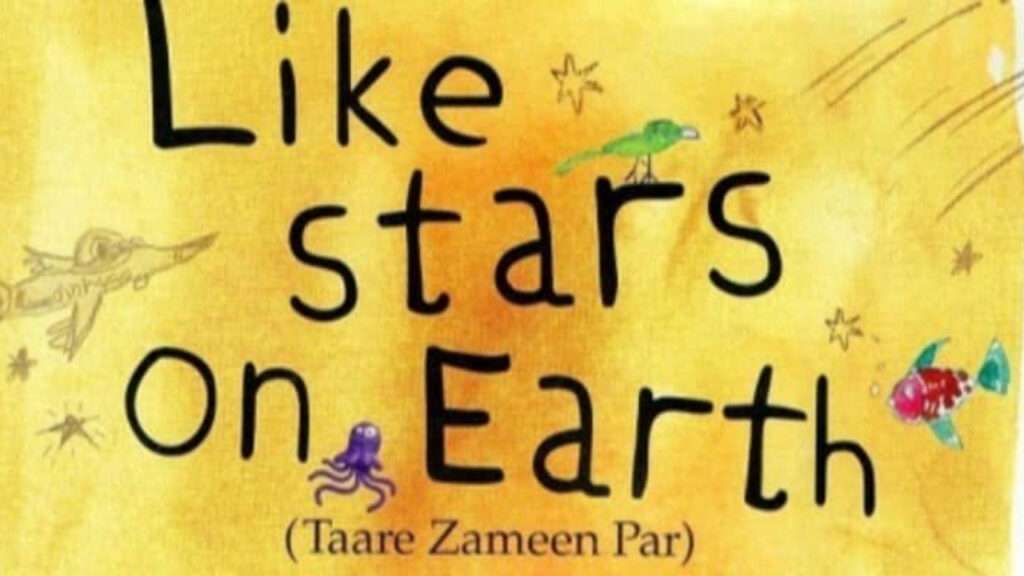
One of my favourite Indian movies is ‘Taare Zameen Par’, released in 2007. The international version was titled as ‘Like Stars on Earth’, directed by Aamir Khan, an actor turned director from India.
This movie portrays a perennial problem of parents, not understanding the exact state of the child under the pressures of expectations and manmade ambitions. The protagonist of the movie is a ‘dyslexic’ child – Ishaan, who has (so-called) troubles in academics but developed a knack for innovative arts and paintings. Ishaan eventually proceeds to excel under the able guidance of a sensible teacher, Nikumbh. Nikumbh understood Ishaan’s problem and helps him unshackle the enforced conventional regulations and explore the real creative sprees in him.
In one scene, Nikumbh goes to explain the problem of the child to his parents. They initially were blaming the child for his ‘intentional mischievousness’.
The father was terming the child’s inability to understand the languages and letters as intentional. Whereas it is a learning disability and to be dealt with utmost understanding and compassion.
To explain the problem, Nikumbh suddenly picks up a Chinese toy-box and instructs the father to read the writings on the box. The father gets annoyed, how can he read a language which is not known to him? ……
Then a momentary silence and the parents realise their lack of understanding about the problem of the child.
[The scene can be watched on YouTube:
https://youtu.be/XjFJ_fu_J3A]
Our vitality is that child in us, who we often choose to misunderstand and consider that it can be enhanced by external means.
But the reality is as the fingerprints of every individual are unique, the types of vitality are also uniquely cast during the time of conception. It cannot speak the language of any other’s vitality. One’s vitality cannot enhance other’s vitality.
Under the influence of this misconception of ‘enhancing vitality’, we waste more internal vitality to force it to learn the language of external vitality. We end up enervating ourselves instead of helping ourselves.
Sooner we understand the unique language of our vitality, the better we can make our health and happiness both.
We cannot teach an unknown language to our vitality ever!
The uniqueness of our vitality does not allow us to enhance it but what we can do is – manage it well!
We have a lot of scopes, consciously to conserve our vitality in most of our physical activities and in our conscious thought processes.
Conscious management of vitality influences the beyond conscious wastage of vitality in our physiological activities and in our beyond conscious thought processes!
A dialectical strategy to our health and happiness.
Thank you…
TAGS
One of my favourite Indian movies is ‘Taare Zameen Par’, released in 2007. The international version was titled as ‘Like Stars on Earth’, directed by Aamir Khan, an actor turned director from India.
This movie portrays a perennial problem of parents, not understanding the exact state of the child under the pressures of expectations and manmade ambitions. The protagonist of the movie is a ‘dyslexic’ child – Ishaan, who has (so-called) troubles in academics but developed a knack for innovative arts and paintings. Ishaan eventually proceeds to excel under the able guidance of a sensible teacher, Nikumbh. Nikumbh understood Ishaan’s problem and helps him unshackle the enforced conventional regulations and explore the real creative sprees in him.
In one scene, Nikumbh goes to explain the problem of the child to his parents. They initially were blaming the child for his ‘intentional mischievousness’.
The father was terming the child’s inability to understand the languages and letters as intentional. Whereas it is a learning disability and to be dealt with utmost understanding and compassion.
To explain the problem, Nikumbh suddenly picks up a Chinese toy-box and instructs the father to read the writings on the box. The father gets annoyed, how can he read a language which is not known to him? ……
Then a momentary silence and the parents realise their lack of understanding about the problem of the child.
[The scene can be watched on YouTube:
https://youtu.be/XjFJ_fu_J3A]
Our vitality is that child in us, who we often choose to misunderstand and consider that it can be enhanced by external means.
But the reality is as the fingerprints of every individual are unique, the types of vitality are also uniquely cast during the time of conception. It cannot speak the language of any other’s vitality. One’s vitality cannot enhance other’s vitality.
Under the influence of this misconception of ‘enhancing vitality’, we waste more internal vitality to force it to learn the language of external vitality. We end up enervating ourselves instead of helping ourselves.
Sooner we understand the unique language of our vitality, the better we can make our health and happiness both.
We cannot teach an unknown language to our vitality ever!
The uniqueness of our vitality does not allow us to enhance it but what we can do is – manage it well!
We have a lot of scopes, consciously to conserve our vitality in most of our physical activities and in our conscious thought processes.
Conscious management of vitality influences the beyond conscious wastage of vitality in our physiological activities and in our beyond conscious thought processes!
A dialectical strategy to our health and happiness.
Thank you…
TAGS
Added to cart
Check out our shop to see what's available
Loading coupons...